
Biomechanics · Medical devices · Human performance
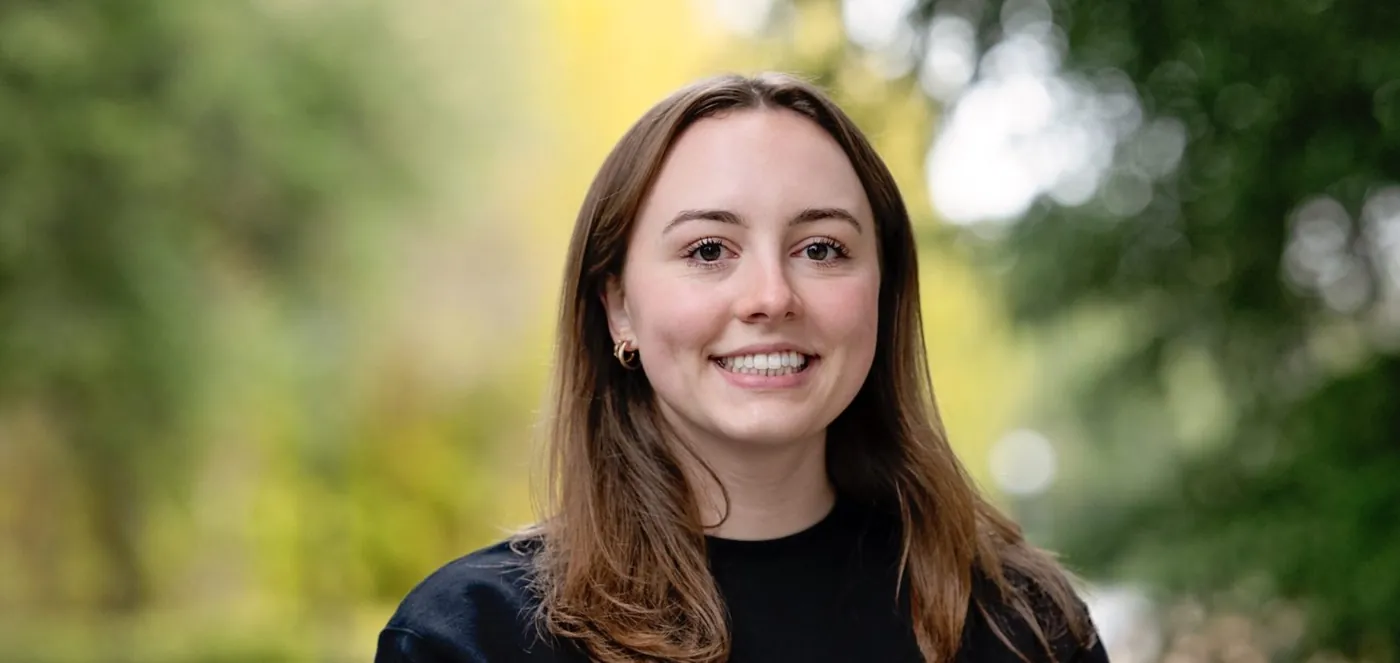
Katelyn Starr: Solving mechanical problems that improve health, mobility and quality of life.
A four-time Canadian jump rope champion who became a Stanford bioengineer, measured human movement in labs in California and Berlin, researched ACL injury in female athletes, and is now training as a mechanical and mechatronics engineer at Waterloo.
Stanford BS Bioengineering ’26 · Waterloo MEng, Health Technologies 2026–28
Biomechanics · motion capture · Python & MATLAB · mechatronics
Chapter I · The athlete
Before the lab, there was the rope.
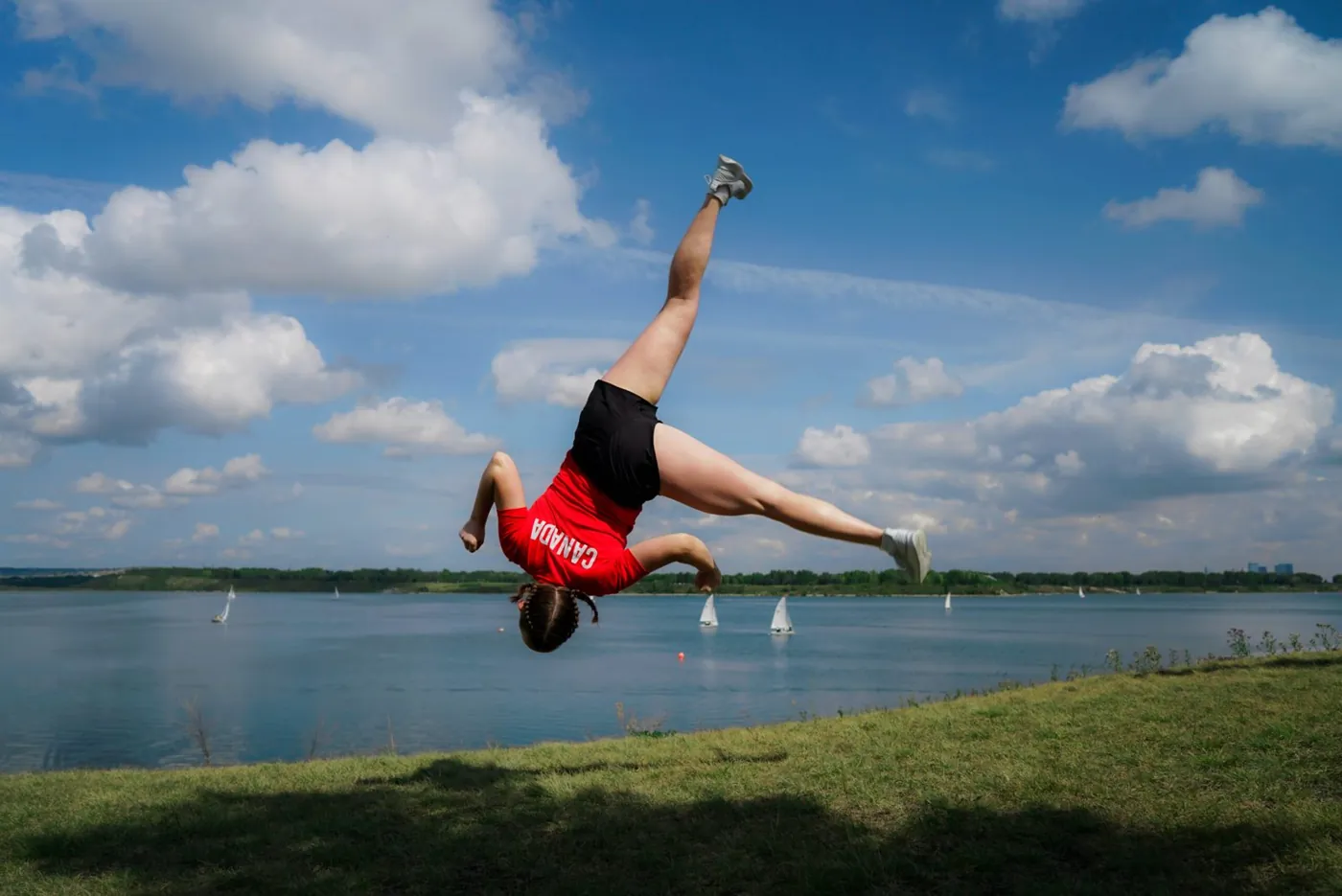
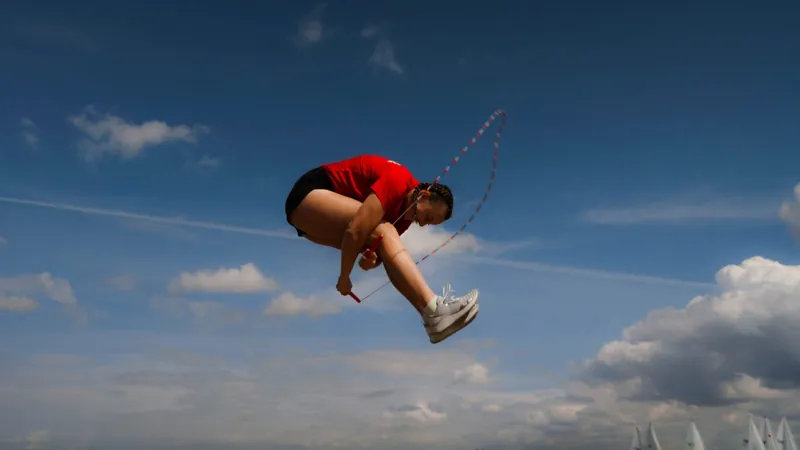
Competitive jump rope is biomechanics at speed: precision, timing and performing under pressure. Katelyn is a four-time Canadian national champion. She won in 2018, 2019 and 2022, all before university, and skipped as a member of Team Canada. The fourth title came later, in the middle of her research.
“I’ve learned the value of precision, persistence, and performing under pressure — skills that I bring into every research project I tackle.”
- 2018
- National champion
- 2019
- National champion
- 2022
- 1st overall · 16–18
The short version
Read the reel as text
I. The athlete: national titles in 2018, 2019 and 2022. II. Stanford: BS Bioengineering and the Placenta Team at Stanford Medicine. III. Berlin: Vicon motion capture, sEMG and ultrasound at Charité. IV. The knee: playing surface and ACL injury-related kinematics, presented at FARM 2025. V. A fourth national title in 2025. VI. Waterloo: MEng, Mechanical & Mechatronics Engineering, Health Technologies.
Chapter II · The question · Stanford, 2022
How does the body work, and how can engineering help it work better?
That curiosity took her to Stanford’s Bioengineering program, where she earned a BS with a 3.8 GPA and a minor in German Studies. The coursework read like a manual for the body.
- Biomechanics
- Systems physiology
- Human biology
- Organic chemistry
- Linear algebra
- Probability & statistics
The rope came with her. From 2023 to 2026 she was president of Stanford Club Jump Rope.
Chapter III · The clinic · 2023–24
The first lesson of clinical research: every sample tells a story only if it’s labelled.
On the Placenta Team at the Stanford University School of Medicine, Katelyn contributed to translational research in a clinical childbirth environment: placental dissections, tissue processing, and blood sample handling, each step labelled and recorded for the researchers downstream.
It taught her clinical workflows, patient-safety protocols and, in her words, “the importance of rigorous documentation in a regulated research setting.” The same habit runs through every dataset she has handled since.
Chapter IV · Berlin · Summer 2024
Measuring movement in a clinical gait lab.
Alongside her German minor and the Stanford in Berlin program, she took a research internship at the Julius Wolff Institute of Charité – Universitätsmedizin Berlin, a leading clinical research institution. She supported patient testing sessions with three instruments. Choose one to see what she did.
What it measures
Reflective markers on anatomical landmarks, tracked by infrared cameras, give a 3D model of how each joint moves.
What Katelyn did
Set up and calibrated the Vicon system, ran its system checks, and placed markers on participants so the kinematics could be trusted.
What it measures
Surface electrodes on the skin pick up the electrical signals muscles produce as they contract.
What Katelyn did
Placed and verified sEMG sensors and supported synchronized, multimodal recordings during gait and functional tasks.
What it measures
B-mode ultrasound images the muscle under the skin, showing how its fibres change length while you move.
What Katelyn did
Performed B-mode ultrasound of the medial gastrocnemius (the calf) to a standardized study protocol, and kept structured session logs.
Chapter V · The knee · 2024–2026
A female athlete, studying injury in female athletes.
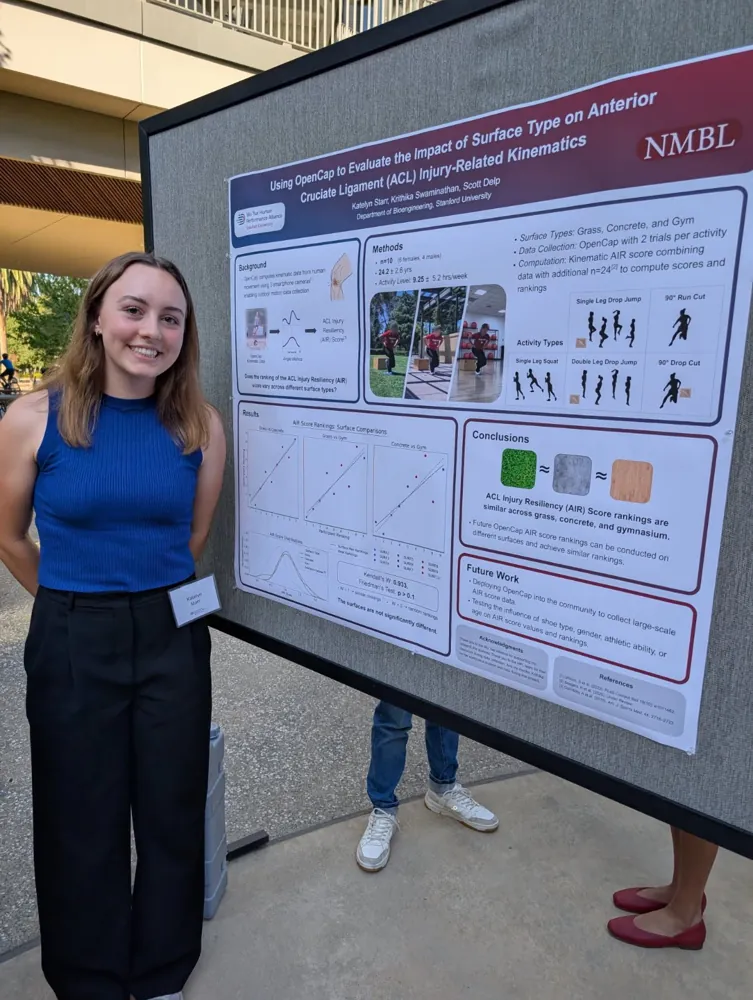
Back at Stanford, the Wu Tsai Human Performance Alliance brought her into the Neuromuscular Biomechanics Lab. Her question: does the surface an athlete plays on change the knee kinematics linked to ACL injury?
Teaching code to see a footstep.
She analysed OpenCap markerless motion-capture data and built Python and MATLAB pipelines to filter the signals, run the statistics and draw the figures. One piece of that: algorithms that find the exact frame a foot lands (initial contact) and leaves the ground (toe-off) in every trial. Every later measurement depends on getting those two moments right.
She presented the findings at the Female Athlete Research Meeting 2025.
Illustrative curve for a typical walking step, not study data.
Meanwhile, May 2025
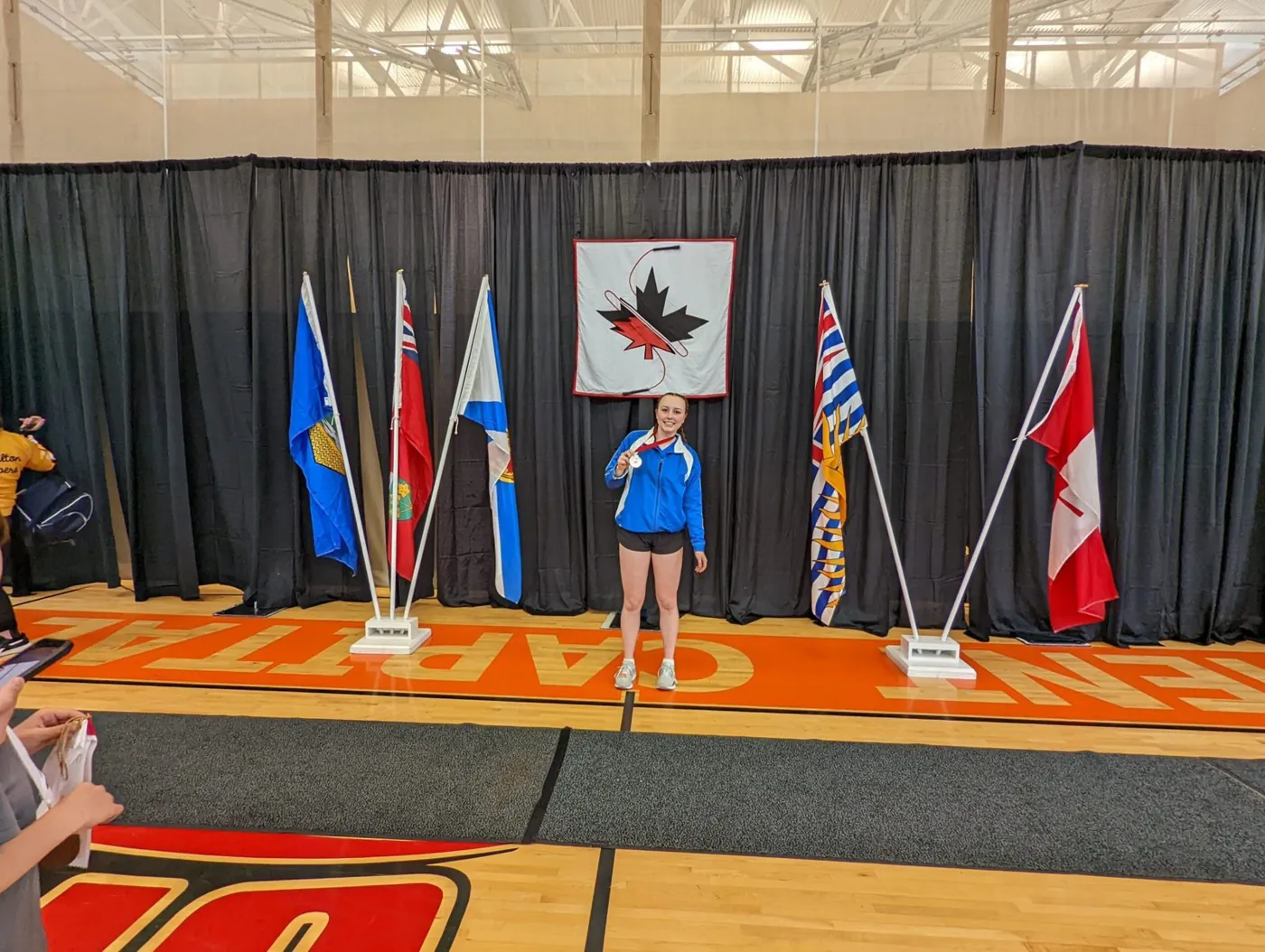
The same year she presented her ACL research, she won her fourth national title: 19+ female, first overall.
Chapter VI · Bedside · 2025–2026
Not every hour at a hospital is about data.
Alongside the lab work, Katelyn volunteered as a Spiritual Care Volunteer at Stanford Health Care. It’s a reminder of who the engineering is for: practical solutions that, as she puts it, “meaningfully improve people’s lives.”
Chapter VII · The build
“I enjoy the iterative nature of engineering.”
Design, build, test, improve. It’s the same loop whether she’s debugging a data pipeline or tuning a closed-loop motorized centrifuge with PID control. Research at Dearborn & Associates added a pull toward orthopedic technology.
Start from the problem: a mechanical question whose answer could improve someone’s health, mobility or quality of life.
Try it · Tune a centrifuge
Get the rotor to speed fast, without overshooting.
A PID controller compares target speed with measured speed and adjusts motor power. Too gentle and it crawls; too aggressive and it overshoots and rings.
OVERSHOOT
0%
SETTLES IN
—
Simplified simulation to show the idea, not her centrifuge’s actual data. The faint line is your previous setting.
Chapter VIII · What’s next · 2026–2028
From understanding the body to building for it.
Katelyn is now a Master of Engineering student in Mechanical & Mechatronics Engineering at the University of Waterloo (September 2026 – April 2028), specialising in Health Technologies. Her goal is a career in mechanical engineering and medical device R&D.
- CAPTURE
- Vicon · OpenCap · sEMG · B-mode ultrasound · UltraTrack
- ANALYSE
- Python · MATLAB · kinematics · gait analysis · statistics · reproducible pipelines
- BUILD
- Mechanical product design · mechatronics · PID control